

Project co-financed by the European Union from the European Regional Development Fund



The Collection of Ancient Art at the National Museum in Warsaw is the largest and most important group of artefacts in Poland connected with ancient cultures (before 476 AD) of the Mediterranean, Egypt and the Middle East. It comprises works of art and handicrafts such as ceramics, glassware, jewellery, weapons, stone sculpture and wooden objects.
The collection numbers close to 20 thousand items, divided according to geographic and cultural criteria into three sections: the Collection of Ancient Middle Eastern Art, the Collection of Ancient Egyptian Art, and the Collection of Classical Art (Greece, Rome and Etruria).
A highlight of the holdings is the magnificent assemblage of Greek painted pottery, including a unique vessel depicting the poet Sappho (https://cyfrowe.mnw.art.pl/en/catalog/486246). Another significant group of objects comes from Egypt – among them a valuable papyrus containing the Book of the Dead (https://cyfrowe.mnw.art.pl/en/catalog/479030). Many exhibits are connected with early modern collecting practices and the Polish fascination with ancient culture – such as a Roman triumphal relief showing Emperor Caracalla and Julia Domna (https://cyfrowe.mnw.art.pl/en/catalog/484448).
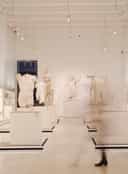
The most precious artefacts can be seen in the Gallery of Ancient Art, where some 1,800 Egyptian, Middle Eastern, Greek, Etruscan and Roman objects are on display.
Curator of the Collection of Ancient Art
Tomasz Dziurdzik
e-mail: tdziurdzik@mnw.art.pl
Zespół
Małgorzata Korzeniowska
e-mail: mkorzeniowska@mnw.art.pl
Kacper Laube
e-mail: klaube@mnw.art.pl
Bartłomiej Żurawski
e-mail: bzurawski@mnw.art.pl
History of the Collection of Ancient Art
The Collection of Ancient Art reflects the deep ties of Polish culture with the legacy of antiquity. Its roots can be traced back to the collection of the Museum of Fine Arts, founded in 1862. By 1866, its inventory already included over one hundred ancient works – mainly Roman and Egyptian. In 1869, they were displayed in the Museum of Antiquities, located in the Kazimierzowski Palace, later renamed the Archaeological Cabinet in 1871. Thirty years later, the collection numbered around 2,300 objects, sourced mainly from private donations.
The collection expanded significantly in the interwar period. It was enriched with artefacts from archaeological excavations, notably the Polish-French mission at Edfu, Egypt (1937–1939), directed by Kazimierz Michałowski. In 1938, the newly-built National Museum in Warsaw opened an exhibition of ancient art. Like other collections in Poland, it suffered severe losses during World War II.
After the war, in 1946, the Association of Polish Museum Professionals resolved to establish within the National Museum in Warsaw a central collection of ancient art in Poland. The guiding idea was that it would be better to develop one major collection rather than maintain many small, fragmented ones. As a result, artefacts from former German collections and Polish private holdings were transferred to Warsaw. In 1958, the USSR returned the Gołuchów collection. The holdings were further expanded with finds from the National Museum’s excavations in Myrmekion (Crimea), and later from research conducted by the University of Warsaw in Egypt, Syria, Iraq, Sudan and Cyprus. As the collection grew, some objects were eventually returned to their original institutions – including Gołuchów Castle, Wilanów Palace and the National Museum in Szczecin.
Today, legal regulations mean that the main sources of new acquisitions are purchases and donations. The collection is also enriched by long-term loans from friendly institutions in Poland and abroad, especially the University of Warsaw and the Musée du Louvre.
Discover the digital collections of the National Museum in Warsaw and explore thousands of works of art — from painting and sculpture to prints, photography and decorative arts. Browse objects, artists and collections, learning their history through detailed descriptions and high-quality reproductions. Visit the site and see the richness of the MNW collections from anywhere, at any time.